
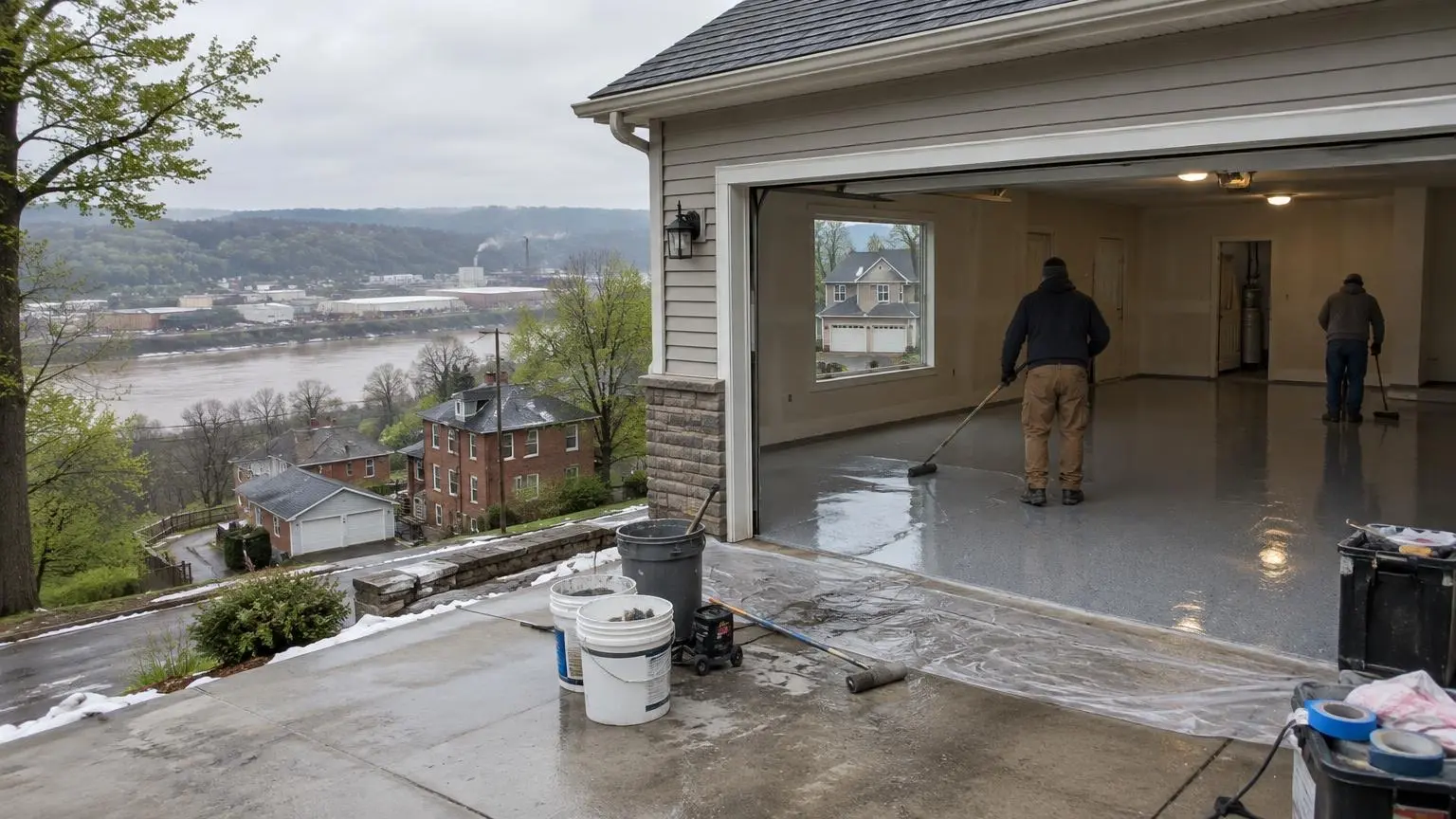
Full systems and UV-stable topcoats
Polyaspartic Coatings in Cincinnati, OH
A hard, clear-curing floor coating that handles sun through the garage door and gets you back on the floor sooner.
- No-cost estimate at your place, including a moisture reading on the concrete before any system is suggested
- A quote on paper itemizing surface prep, each coat and the final total
- Surface prep explained up front: grinding, crack repair and old coating removal
When a Polyaspartic Floor Coating Makes Sense
Polyaspartic coatings are the faster, more sun-resistant cousin of epoxy, and in Cincinnati we use them in two ways. Sometimes a polyaspartic floor coating is the whole system, base to topcoat. More often it is the topcoat over an epoxy base, so you get epoxy's build and bond under a surface that resists sunlight and abrasion. Either way, the reasons people choose it are the same: shorter downtime and a finish that keeps its color where light hits it.
Faster return to service
In HomeGuide's comparison, polyaspartic fully cures in 1 to 2 days and takes heavy vehicles in about 24 to 48 hours, while ordinary epoxy can take as much as a week. People, per Bob Vila's guide, can walk on polyaspartic in 3 to 4 hours and drive on it in 24 hours. That matters for a household with one garage and two cars, for a family that cannot empty the garage for a week, and especially for a business that has to close to have a floor done. Bob Vila notes a business might be shut for as little as a day or two.
Sunlight and color
Standard epoxy is not UV stable. In HomeGuide's ratings, epoxy scores poor to fair against UV, while polyaspartic scores excellent. On a garage that faces south or west, the strip of floor inside the door can sit in sun for hours with the door open, and plain epoxy there can yellow or chalk. A polyaspartic topcoat holds its color and clarity in that light. It is also our default over metallic and light-colored floors, where yellowing shows most.
Thinner coats, so prep matters more
According to HomeGuide, each polyaspartic coat is roughly 2 to 6 mils thick, where an epoxy coat is 10 to 20 mils. Thin, fast coats do not hide a poorly prepared floor or fill much in the way of surface flaws. That is one reason we often put an epoxy base underneath, and why grinding and crack repair come first on every job. A thin coating over a rough or contaminated slab is the fastest way to a failed floor.
Working with the weather
Polyaspartic cures by reacting with humidity, and it sets quickly. On a muggy summer day in the Ohio Valley, working time shrinks. In a cool garage, it slows down. Before each coat we check air temperature and relative humidity, compare the concrete's temperature with the dew point, and we mix in batches that can be spread before they set. If conditions are off, we adjust the plan or wait. This is part of why Bob Vila describes polyaspartic as a product not suited to DIY.
Where polyaspartic fits
- Sun-facing garages that spend hours with the door up
- Households that need the garage back within a day or two
- Restaurants, retail floors and offices that can only close briefly
- Topcoats over metallic and light-colored epoxy
- Entry areas and sunrooms with sun through glass
- Floors where abrasion resistance matters more than thick build
Polyaspartic over older concrete
With so much of Cincinnati's housing built before 1940, according to Point2Homes' census summary, we often coat slabs that are uneven or patched. On those floors we usually lay an epoxy base or a flake broadcast first to build thickness, then finish with polyaspartic. On newer, flatter garages in the northern suburbs, a full polyaspartic system can be a good fit after grinding. We will tell you which approach your slab calls for after testing it.
Care
Polyaspartic is hard and stain resistant, but grit still scratches any finish. Sweep regularly, rinse off road salt, and mop with a pH-neutral product. Pads under jack stands and kickstands prevent dents.
Polyaspartic Options
Polyaspartic can be the whole floor or the layer that protects it.
Full polyaspartic system
Base and topcoat both polyaspartic, for fast turnaround on sound, ground concrete.
Polyaspartic topcoat over epoxy
Epoxy underneath for thickness and adhesion, capped with a clear coat that resists sun and scuffing.
Polyaspartic flake floor
A flake broadcast sealed with polyaspartic for texture and quick return to use.
Clear coat for metallic floors
A non-yellowing topcoat over metallic or light epoxy where color must stay true.
Anti-slip finish
Fine grit in the final coat for entries and floors that get wet.
Typical Polyaspartic Coating Costs
| Job | Published range | Source |
|---|---|---|
| Polyaspartic, per sq ft | $5 to $12 | HomeGuide |
| One-car garage | $1,400 to $4,700 | HomeGuide |
| Two-car garage | $2,000 to $6,900 | HomeGuide |
| Three-car garage | $2,900 to $10,400 | HomeGuide |
| 500 sq ft floor | $2,500 to $6,000 | HomeGuide |
| Typical job total | $1,440 to $3,240 | Bob Vila |
These come from national cost guides, and the two guides do not agree on every number. What your floor costs depends on its size, prep and the system we specify, and that number goes on a written estimate before we start.
How a Polyaspartic Job Runs
1. Test and plan
After testing the slab, we choose between all-polyaspartic and an epoxy base under a polyaspartic clear coat.
2. Grind and repair
Thin coats show every flaw, so the slab is ground and patched carefully.
3. Check conditions
Air temperature, humidity and dew point are checked against the slab before mixing.
4. Apply in batches
Small batches are mixed and spread quickly, coat by coat.
5. Fast hand-back
We tell you when to walk on the floor and when to park, often within a day.
Why Choose Us for Polyaspartic Coatings
The right layer for the job
We use polyaspartic where its speed and UV resistance help, and an epoxy base where the slab needs build.
Conditions checked before mixing
A fast-curing product leaves no room to guess, so humidity and slab temperature are measured each time.
Clear turnaround times
Before work begins, you know when foot traffic, moving belongings back and driving on the floor are each okay.
Polyaspartic Coatings Questions
Is polyaspartic better than epoxy?
Each does a different job. On HomeGuide's UV scale, polyaspartic rates excellent and epoxy only poor to fair, and polyaspartic also cures far faster. Epoxy builds thicker per coat and bonds well to prepared concrete, so many floors use both.
How long does a polyaspartic floor coating take to cure?
Bob Vila's guide says about 3 to 4 hours before walking and 24 hours before driving. HomeGuide puts the full cure at 1 to 2 days. Temperature and humidity on install day shift those times.
What does a polyaspartic garage floor cost?
HomeGuide lists $5 to $12 per square foot and about $2,000 to $6,900 for a two-car garage. We price your floor after testing and measuring it.
Can I put polyaspartic down myself?
Bob Vila's guide says polyaspartic is not a DIY product. It sets fast, so you work in small mixes and get each one down quickly, and mistakes are hard to fix.
Polyaspartic Coatings Service Areas
- Epoxy Flooring in Cincinnati, OH
- Epoxy Flooring in Mason, OH
- Epoxy Flooring in West Chester Township, OH
- Epoxy Flooring in Blue Ash, OH
- Epoxy Flooring in Sharonville, OH
- Epoxy Flooring in Montgomery, OH
- Epoxy Flooring in Loveland, OH
- Epoxy Flooring in Indian Hill, OH
- Epoxy Flooring in Madeira, OH
- Epoxy Flooring in Anderson Township, OH
- Epoxy Flooring in Milford, OH
- Epoxy Flooring in Fairfield, OH
- Epoxy Flooring in Springdale, OH
- Epoxy Flooring in Forest Park, OH
- Epoxy Flooring in Norwood, OH
- Epoxy Flooring in Wyoming, OH
- Epoxy Flooring in Lebanon, OH
- Epoxy Flooring in Liberty Township, OH
- Epoxy Flooring in Green Township, OH
- Epoxy Flooring in Colerain Township, OH
- Epoxy Flooring in Delhi Township, OH
- Epoxy Flooring in Covington, KY
- Epoxy Flooring in Florence, KY
- Epoxy Flooring in Fort Thomas, KY
- Epoxy Flooring in Union, KY
Get a Polyaspartic Coatings Estimate
Free on-site estimates for polyaspartic coatings across Greater Cincinnati.