
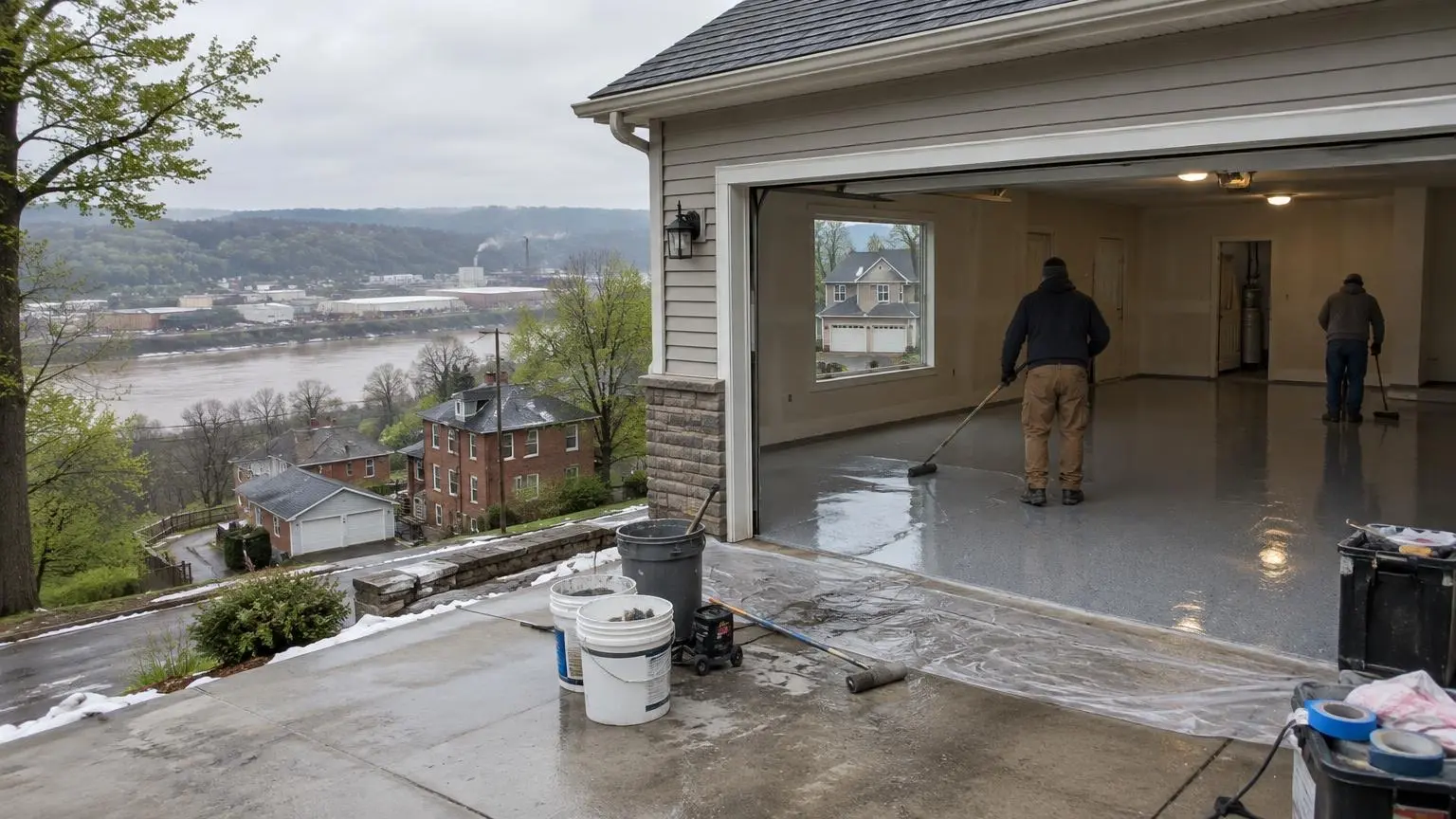
Garage, basement and commercial floors on both sides of the river
Epoxy Flooring in Cincinnati, OH
Resin floors built over tested, ground and repaired concrete, for century-old garages, damp basements and busy work spaces.
- No-cost estimate at your place, including a moisture reading on the concrete before any system is suggested
- A quote on paper itemizing surface prep, each coat and the final total
- Surface prep explained up front: grinding, crack repair and old coating removal
Concrete Coatings for an Old River City
Epoxy flooring in Cincinnati, OH, almost always means working on a slab with a long past. Point2Homes, summarizing American Community Survey data, puts the city's median home at 1951, and 40.8% of its housing units date from 1939 or earlier. That is a lot of concrete poured before modern vapor barriers, painted more than once, patched over plumbing work and stained by decades of cars. We coat garages, basements, shops and commercial floors across the city and its suburbs, and nearly every estimate begins with the question of what that concrete needs before any resin goes on it.
What a coating does for concrete
Bare concrete is porous. It soaks up oil, brake fluid, winter slush and spilled paint, and its surface keeps shedding fine gray dust no matter how often it is swept. An epoxy floor coating seals that surface under a hard, continuous film. Spills sit on top, where a mop or squeegee can reach them. The floor gets brighter because the finish reflects light, and a flake or texture additive gives traction where shoes and tires get wet. A good system is also thick enough to hide minor surface wear and tough enough to take rolling tool chests, jack stands and foot traffic.
Older slabs need more prep, not more paint
Most failed floors we see were coated over a problem instead of fixing it. Hardware-store kits depend on an acid etch, and that step leaves crumbly surface concrete, old sealers and oil in place, so the coating lets go wherever warm tires park. Our crew diamond grinds instead, wall to wall, until the concrete is open and clean. Then we fill cracks, rebuild chipped control joints, and level spalled or pitted patches. On a pre-war slab, that prep is often the biggest part of the labor, and the quote breaks it out separately, letting you track exactly what each dollar pays for.
Moisture comes from below
A slab that sits on soil keeps exchanging moisture with the ground. In a basement, or in a detached garage poured without a plastic sheet underneath, that moisture pushes up into the concrete and can lift a coating from below. The signs are white powdery deposits, dark patches after rain, and blisters in an old coating. We test before we quote, every time. A wet reading calls for a primer formulated to handle moisture, and if a floor is too wet for any coating to last, we will say so plainly rather than sell you a floor that fails.
Winter salt, summer humidity
Wikipedia places Cincinnati at the southern edge of the humid continental climate zone. An average winter brings about 23.3 inches of snow, and January lows average 23.6 F, so streets get salted and that brine rides into garages on every tire. Bare concrete absorbs it, and freeze-thaw cycles then scale and pit the surface near the door. Summers swing the other way: highs reach 90 F or more on about 27 days a year, and the air is often thick. Humid air shortens working time for resins and can leave a cloudy film if moisture condenses on a cool slab. We plan around both seasons, choosing textures and colors that hide salt residue and checking the dew point against the slab temperature before every coat.
Two rivers and a flood record
Cincinnati's relationship with the Ohio River shapes how we think about low floors. Wikipedia's account of the 1937 flood says the river crested at 79.9 feet on January 26, 1937, more than 25 feet above flood stage, and that about 12 square miles of the city went under water. Nobody can coat a floor to stop a flood, but a sealed floor in a low basement or riverside garage is far easier to hose out and dry than bare concrete that has absorbed muddy water. For spaces that see standing water, we favor solid systems with coved edges and avoid finishes that trap grit.
Choosing a system
- Solid-color epoxy suits basements, workshops and utility spaces where a clean, bright floor matters most.
- Chip flake floors hide dirt and salt residue between cleanings and add grip. They are the most common garage choice.
- Polyaspartic coatings cure fast and resist sunlight, which helps on garage floors near an open door and on jobs that need to return to service quickly.
- Metallic epoxy gives a marbled, glossy look for basements, bars, offices and retail floors.
- Commercial systems use thicker, high-solids resins for kitchens, warehouses and production floors.
Sample boards come along to the visit, so colors get judged under your own lights before you commit.
What drives epoxy flooring cost
The published national ranges are a useful starting point. HomeGuide's installed price for epoxy runs $4 to $10 per square foot, with a two-car garage at roughly $1,600 to $5,800, while polyaspartic runs $5 to $12 per square foot. Where a floor lands in that spread depends on its size, how much grinding and patching it needs, whether a previous coating must be stripped first, and the finish you settle on. A moisture-mitigating primer adds cost on a damp slab. We price after testing the concrete, and the written number we give you is the price.
What to ask epoxy flooring contractors
When you compare epoxy floor installers, ask a few direct questions. Do they grind the whole floor, edges included, or etch it with acid? Do they test for moisture before quoting? What is the total thickness of the system, and what is the topcoat? How long until you can walk on it, and how long until you can park? What happens if they find more cracks than expected? Good epoxy flooring companies answer those questions in writing, and so do we. If a quote does not say what prep is included, assume it is not.
Living with a coated floor
Sweep or blow out grit often, because sand and salt under tires act like sandpaper on any topcoat. Rinse winter slush and road salt off before it dries into a crust. A gentle, pH-neutral floor cleaner on a soft mop does the job; skip harsh solvents. Use plywood or pads under jack stands, kickstands and heavy equipment feet. Wipe up oil, gasoline and battery acid soon after a spill. With that routine, a well-installed floor keeps its color and gloss for many years.
Towns We Cover Around Cincinnati
We work throughout Cincinnati itself, from the river neighborhoods to the hilltop suburbs inside the city line. North of the city we cover Norwood, Wyoming, Springdale, Forest Park, Sharonville, Blue Ash, Madeira, Montgomery and Indian Hill in Hamilton County, along with Fairfield, West Chester Township and Liberty Township in Butler County and Mason and Lebanon in Warren County. On the east side we serve Loveland, Milford and Anderson Township. To the west we cover Green, Colerain and Delhi townships. Across the Ohio River in Kentucky, we work in Covington, Fort Thomas, Florence and Union. Floors differ a great deal across that map. City and inner-ring homes tend to have older slabs with paint, patches and no vapor barrier, while the Butler, Warren and Boone County subdivisions built since the 1990s have larger attached garages with sound concrete that still needs full grinding. Click any town below for its housing ages and the floor issues we watch for there.
- Epoxy Flooring in Cincinnati, OH
- Epoxy Flooring in Mason, OH
- Epoxy Flooring in West Chester Township, OH
- Epoxy Flooring in Blue Ash, OH
- Epoxy Flooring in Sharonville, OH
- Epoxy Flooring in Montgomery, OH
- Epoxy Flooring in Loveland, OH
- Epoxy Flooring in Indian Hill, OH
- Epoxy Flooring in Madeira, OH
- Epoxy Flooring in Anderson Township, OH
- Epoxy Flooring in Milford, OH
- Epoxy Flooring in Fairfield, OH
- Epoxy Flooring in Springdale, OH
- Epoxy Flooring in Forest Park, OH
- Epoxy Flooring in Norwood, OH
- Epoxy Flooring in Wyoming, OH
- Epoxy Flooring in Lebanon, OH
- Epoxy Flooring in Liberty Township, OH
- Epoxy Flooring in Green Township, OH
- Epoxy Flooring in Colerain Township, OH
- Epoxy Flooring in Delhi Township, OH
- Epoxy Flooring in Covington, KY
- Epoxy Flooring in Florence, KY
- Epoxy Flooring in Fort Thomas, KY
- Epoxy Flooring in Union, KY
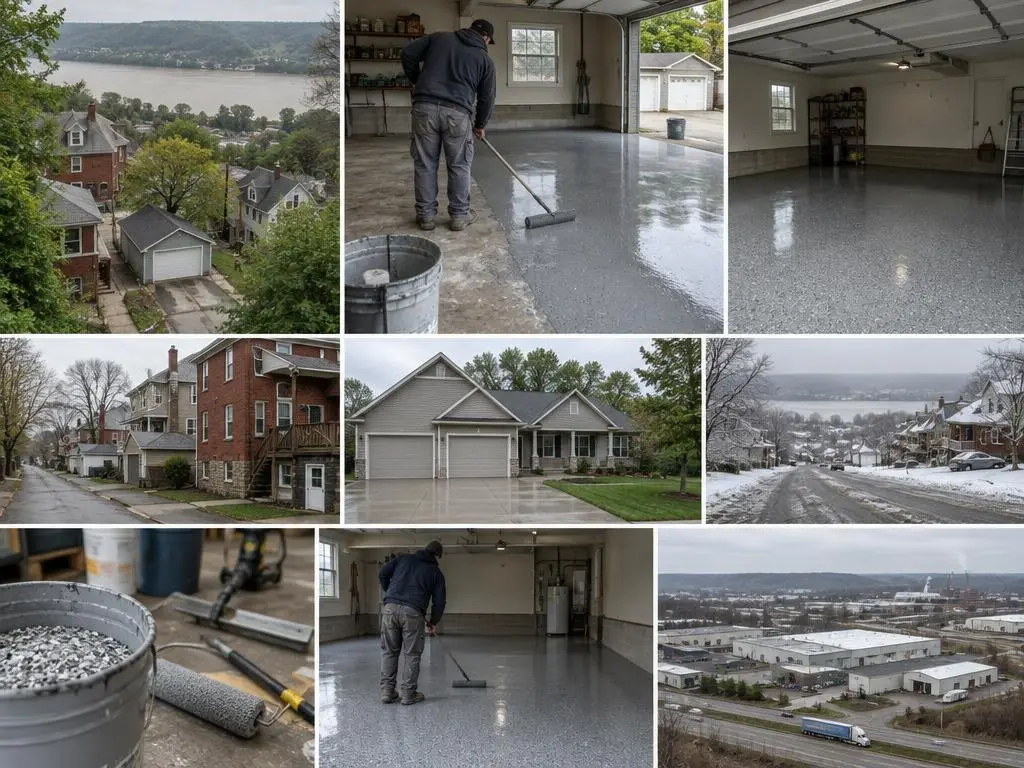
Our Epoxy Flooring Services
Six coating services for the floors people around Cincinnati actually use: garages that take winter slush, basements in old houses, and work floors that never get a day off.
Epoxy Garage Floors
Garage slabs ground, patched and sealed so winter slush, oil drips and hot tires stay on top.
Learn more →Chip Flake Flooring
Broadcast vinyl flake floors that hide salt, dust and tire marks and give wet feet some grip.
Learn more →Polyaspartic Coatings
Quick-setting coatings that stand up to sunlight, for garages and floors that cannot sit idle long.
Learn more →Metallic Epoxy Floors
Hand-worked, swirled resin floors with real depth for basements, bars, offices and stores.
Learn more →Commercial Epoxy Flooring
High-build resin floors for warehouses, shops, kitchens and production spaces that run every day.
Learn more →Basement Floor Coatings
Moisture-tested basement floor epoxy that turns a damp, dusty slab into usable living space.
Learn more →Common Questions
What does epoxy flooring cost in Cincinnati?
On HomeGuide's national numbers, installed epoxy runs $4 to $10 per square foot, about $1,200 to $3,900 for a one-car garage and $1,600 to $5,800 for a two-car garage. Older Cincinnati slabs tend to call for extra grinding and crack filling, which moves a floor toward the upper end. Once we have measured and tested the floor, you get the price in writing.
Are there drawbacks to an epoxy floor?
Epoxy is unforgiving of poor prep. If it goes over oil, old sealer or a damp slab, it can peel or blister. HomeGuide gives ordinary epoxy only a poor-to-fair UV rating and says reaching full cure may take as long as a week, and a high-gloss surface gets slippery once water is on it. Grinding, moisture testing, a UV-stable topcoat and a flake or grit texture deal with each of those.
What is the cost of epoxy resin flooring for a whole room or basement?
Using HomeGuide's $4 to $10 per square foot range, a 500 square foot basement works out to roughly $2,000 to $5,000 for epoxy. For 100% solids commercial or industrial systems, HomeAdvisor's figure is $12 or more per square foot. A damp basement may need a moisture-mitigating primer, which adds to the total.
Is there a high demand for epoxy flooring right now?
Garage and basement coatings are popular because they turn a dusty slab into usable space without tearing anything out. In practice that means installers book up during mild-weather months, when slab and air temperatures make scheduling easier. Calling early gives you more choice of install dates.
Will road salt ruin a coated garage floor?
A cured, well-bonded coating holds up to salt far better than bare concrete, which salt and freeze-thaw cycles can scale and pit. Salt and slush still leave a white crust that dulls the finish and gets gritty under tires. Rinse or squeegee it out through the winter and choose a flake color that hides residue between cleanings.
Can you coat a basement that has had water in it?
Often, yes, after testing. A basement with occasional dampness can usually take a coating over a moisture-tolerant primer. Active leaks, standing water or cracks that let water in need to be fixed first, because no floor coating stops water entering through walls or open cracks.
How long does an epoxy floor take to install?
A typical garage or basement is a one- to three-day job, with prep and system choice setting the pace. HomeGuide advises giving epoxy 2 to 7 days before cars go back on it, whereas polyaspartic is ready for heavy vehicles in roughly 24 to 48 hours. You will know the exact walk-on and drive-on times for your floor before we start.
Do you work in Northern Kentucky as well as Ohio?
Yes. We coat floors in Covington, Fort Thomas, Florence and Union as well as Cincinnati and the Ohio suburbs. The process and the written quote are the same on both sides of the river.
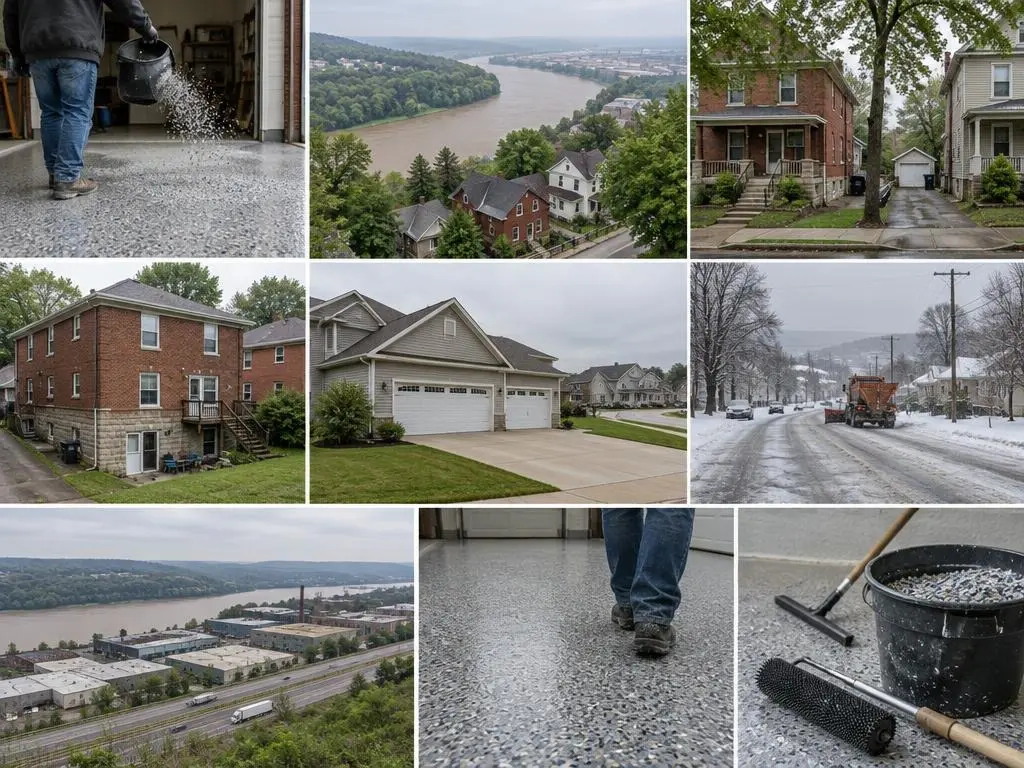
Why Homeowners Call Epoxy Flooring Cincinnati
Testing before talking price
We check the slab for moisture during the estimate, so the system and primer in your quote match the concrete you actually have.
Grinding, not acid etching
Every floor is diamond ground edge to edge. It is slower and dustier for us, and it is the main reason a coating stays bonded.
We watch the air on install day
Temperature, humidity and slab temperature are checked before each coat. If condensation could form on the slab, we wait.
A price you can read
Square footage, prep steps, every coat and the bottom line are all on the quote. Changes only happen with your written approval.
Book a Free Floor Estimate
We come out, test the slab and hand you a price in writing for Cincinnati and Northern Kentucky floors.