
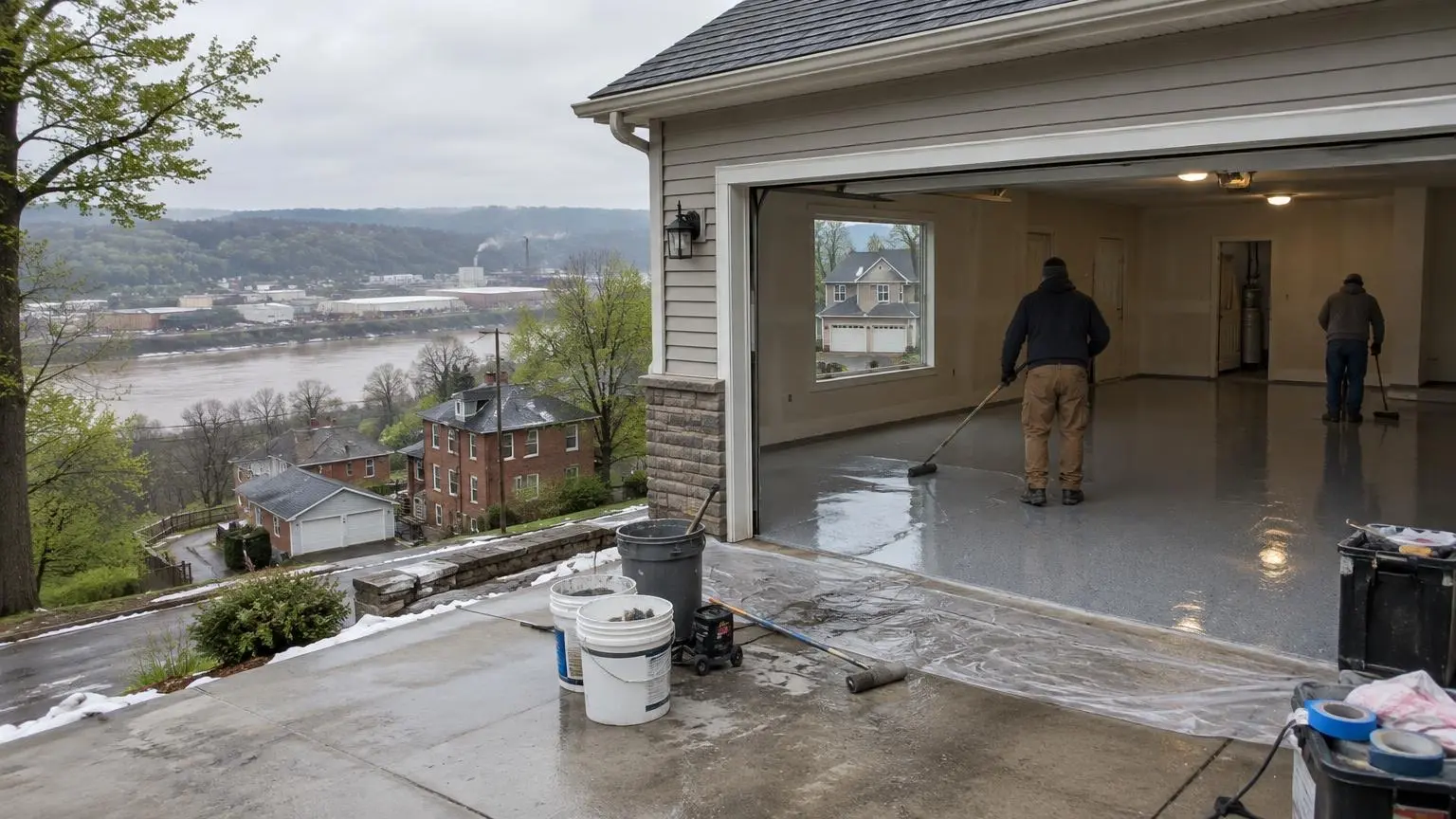
One-, two- and three-car garages, attached or detached
Epoxy Garage Floors in Cincinnati, OH
A sealed garage floor that keeps road salt, oil and meltwater sitting on top, ready to be pushed out with a squeegee.
- No-cost estimate at your place, including a moisture reading on the concrete before any system is suggested
- A quote on paper itemizing surface prep, each coat and the final total
- Surface prep explained up front: grinding, crack repair and old coating removal
Garage Floor Coating Built for Ohio Valley Winters
Epoxy garage floors make up more of our Cincinnati work than anything else, and February explains why. Cars come home covered in brine and slush, it drips off the wheel wells and pools on the slab, and bare concrete drinks it in. Over a few winters that salty water stains the slab, loosens its surface and starts to pit it. A garage floor coating seals the concrete so meltwater sits on top. You push it out the door with a squeegee instead of watching it soak in.
What we see in local garages
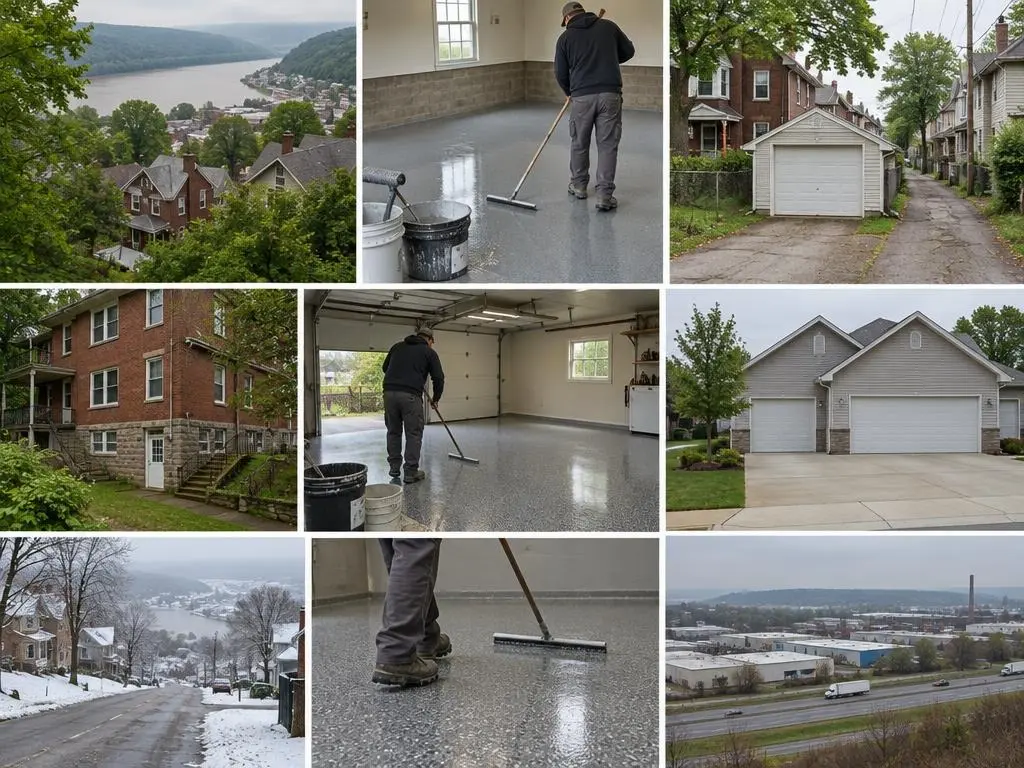
Cincinnati has a mix of garages you do not find everywhere. In the city and older inner suburbs, many homes have a detached one-car or two-car garage behind the house, often poured decades ago, often painted at least once. Point2Homes' summary of census data puts the city's median home at 1951. In newer subdivisions to the north and in Northern Kentucky, attached two- and three-car garages are standard, and the slab may still carry the builder's curing compound or a clear sealer. Each needs a different starting point, so we look before we recommend anything.
When a garage slab is due for coating
- White salt rings or a crusty film where the cars park
- Flaking or pitting in the top layer of concrete near the door
- Oil and transmission fluid stains that will not scrub out
- Gray dust that returns a day after sweeping
- Old paint or a kit coating lifting in the tire paths
- Cracks or chipped control joints that collect dirt
Why garage floor epoxy fails, and how we avoid it
Peeling is almost always a bonding problem. Kits from the hardware store tell you to scrub the floor with acid. That brightens the top, yet the soft cement layer, leftover sealer and oil all stay put. The coating sticks to that loose layer instead of solid concrete. Then a warm tire sits on it overnight, cools, and pulls it up. We diamond grind the entire slab, including the edges along the walls, vacuum it, degrease stubborn spots and test the surface. A ground floor gives the resin open, sound concrete to hold onto.
Cracks, joints and old patches
Garage slabs move. Most have control joints cut into them, and many older ones have settlement cracks, a sunken patch by the drain or a crumbling lip at the garage door. Cracks and chips get filled using a patch compound designed to sit under resin, then we rebuild broken joint edges and level shallow low spots. Repairs appear as a separate line on the quote, so the cost and the reason for each are plain to see.
Moisture under detached garages
Many older detached garages were poured straight onto the ground with nothing between the soil and the concrete. Vapor rising through a slab like that can lift a coating from underneath. During the estimate we test the slab, and if the meter reads wet, the system starts with a primer formulated for damp concrete. If a floor has a drainage problem, like water running in under the door every storm, we will point it out so it can be dealt with first.
Choosing the finish
In Cincinnati, the full chip flake broadcast is the usual garage pick: salt film, dust and tire scuffs disappear into it between cleanings, and the texture gives your feet something to hold on a wet slab. Others go with solid color plus a sparse sprinkle of flake, or solid color with anti-slip grit mixed into the topcoat. Every system gets a clear, hard topcoat. On garages where sun comes through the open door for hours, we use a polyaspartic topcoat because it holds up to UV much better than plain epoxy.
After install
HomeGuide advises keeping cars off a new epoxy floor for 2 to 7 days, depending on the product. Polyaspartic systems return to service faster. You get set times for foot traffic, for returning shelves and bins, and for pulling the car in. Through winter, rinse or squeegee out salt slush every so often, and slip a pad beneath jack stands and motorcycle kickstands.
What a Garage Job Includes
A full garage floor coating covers everything from the overhead door to the far wall, edges and joints included.
Full-floor diamond grinding
Diamond grinding across the slab and along the walls takes off sealer, paint, stains and soft top concrete so the coating bonds.
Crack and joint repair
Cracks, chipped joints and pitting filled and leveled, leaving one even surface once coated.
Moisture test and primer
A slab moisture check during the estimate, plus a moisture-tolerant primer whenever the readings call for it.
Base coat, flake or color
A bonded epoxy base, then a full or partial flake broadcast or a solid color layer.
Clear topcoat
A hard, clear topcoat, polyaspartic where sun reaches the floor, with grit added if you want more traction.
Old coating removal
Flaking paint or failed DIY epoxy is removed by grinding before we lay the new coats.
Steps and stem walls
Optional: the coating extended up entry steps and over the low concrete ledge at the base of the walls.
Typical Garage Floor Coating Costs
| Garage | Published range | Source |
|---|---|---|
| Installed epoxy, per sq ft | $4 to $10 | HomeGuide |
| One-car garage, epoxy | $1,200 to $3,900 | HomeGuide |
| Two-car garage, epoxy | $1,600 to $5,800 | HomeGuide |
| Three-car garage, epoxy | $2,300 to $8,600 | HomeGuide |
| Two-car garage, polyaspartic | $2,000 to $6,900 | HomeGuide |
| Crack and chip patching | $25 to $250 | This Old House |
These are national published ranges, not a Cincinnati price list. Grinding off old paint, how much crack repair is needed and your choice of finish all shift the total. Whatever your written estimate says is the amount you pay.
How a Garage Floor Gets Done
1. Walkthrough and test
We measure, check the concrete's moisture level and note stains, cracks, joints and any old coating.
2. Written quote
You get the system, coat count, prep and total in writing before anything is scheduled.
3. Grind and repair
Diamond grinding, vacuuming and degreasing come first, followed by filling cracks and joints.
4. Coat
Base coat, then flake or pigment, with a clear wear layer last, applied when air temperature, humidity and slab temperature are in range.
5. Cure and hand back
You get times for foot traffic, putting your things back and parking, set by the product used and that day's weather.

Why Choose Us for Epoxy Garage Floors
Every floor ground edge to edge
No acid etching. Grinding is what lets the coating grip solid concrete instead of an old sealer.
Repairs priced in the open
Crack and joint work is a separate line on the quote, so nothing appears on install day.
Winter-minded finish advice
We suggest flake colors and textures that hide salt residue and stay grippy when slush melts.
Epoxy Garage Floors Questions
How much does an epoxy garage floor cost in Cincinnati?
HomeGuide's national range is $1,600 to $5,800 for a two-car garage in epoxy and $2,000 to $6,900 in polyaspartic. Older Cincinnati garages with paint or many cracks tend to need more prep, which pushes the total up. Your written number comes after we measure and test the floor.
Does road salt hurt a coated garage floor?
Salt does far less damage to a cured coating than to bare concrete. It still leaves a gritty white crust that dulls the topcoat over time, so rinse or squeegee it out during winter. A flake finish hides the residue between cleanings.
Can garage coating happen during Cincinnati winters?
Resin needs the slab and air within a temperature range to cure properly. In cold months we can sometimes work in an attached, heated garage. Unheated detached garages are usually better scheduled for milder weather, and we will tell you which applies to yours.
Why did my DIY garage floor epoxy peel?
Most kits rely on acid etching and a thin coat, which leaves old sealer, oil and weak concrete under the coating. Warm tires then lift it. A diamond-ground floor with a thicker system and a hard topcoat bonds much better.
When can the car go back in the garage?
HomeGuide advises giving epoxy 2 to 7 days before cars go back on it, whereas polyaspartic is ready for heavy vehicles in roughly 24 to 48 hours. We give you an exact time based on the system and the temperature on install day.
Epoxy Garage Floors Service Areas
- Epoxy Flooring in Cincinnati, OH
- Epoxy Flooring in Mason, OH
- Epoxy Flooring in West Chester Township, OH
- Epoxy Flooring in Blue Ash, OH
- Epoxy Flooring in Sharonville, OH
- Epoxy Flooring in Montgomery, OH
- Epoxy Flooring in Loveland, OH
- Epoxy Flooring in Indian Hill, OH
- Epoxy Flooring in Madeira, OH
- Epoxy Flooring in Anderson Township, OH
- Epoxy Flooring in Milford, OH
- Epoxy Flooring in Fairfield, OH
- Epoxy Flooring in Springdale, OH
- Epoxy Flooring in Forest Park, OH
- Epoxy Flooring in Norwood, OH
- Epoxy Flooring in Wyoming, OH
- Epoxy Flooring in Lebanon, OH
- Epoxy Flooring in Liberty Township, OH
- Epoxy Flooring in Green Township, OH
- Epoxy Flooring in Colerain Township, OH
- Epoxy Flooring in Delhi Township, OH
- Epoxy Flooring in Covington, KY
- Epoxy Flooring in Florence, KY
- Epoxy Flooring in Fort Thomas, KY
- Epoxy Flooring in Union, KY
Get an Epoxy Garage Floors Estimate
Free on-site estimates for epoxy garage floors in Cincinnati and the surrounding suburbs.