
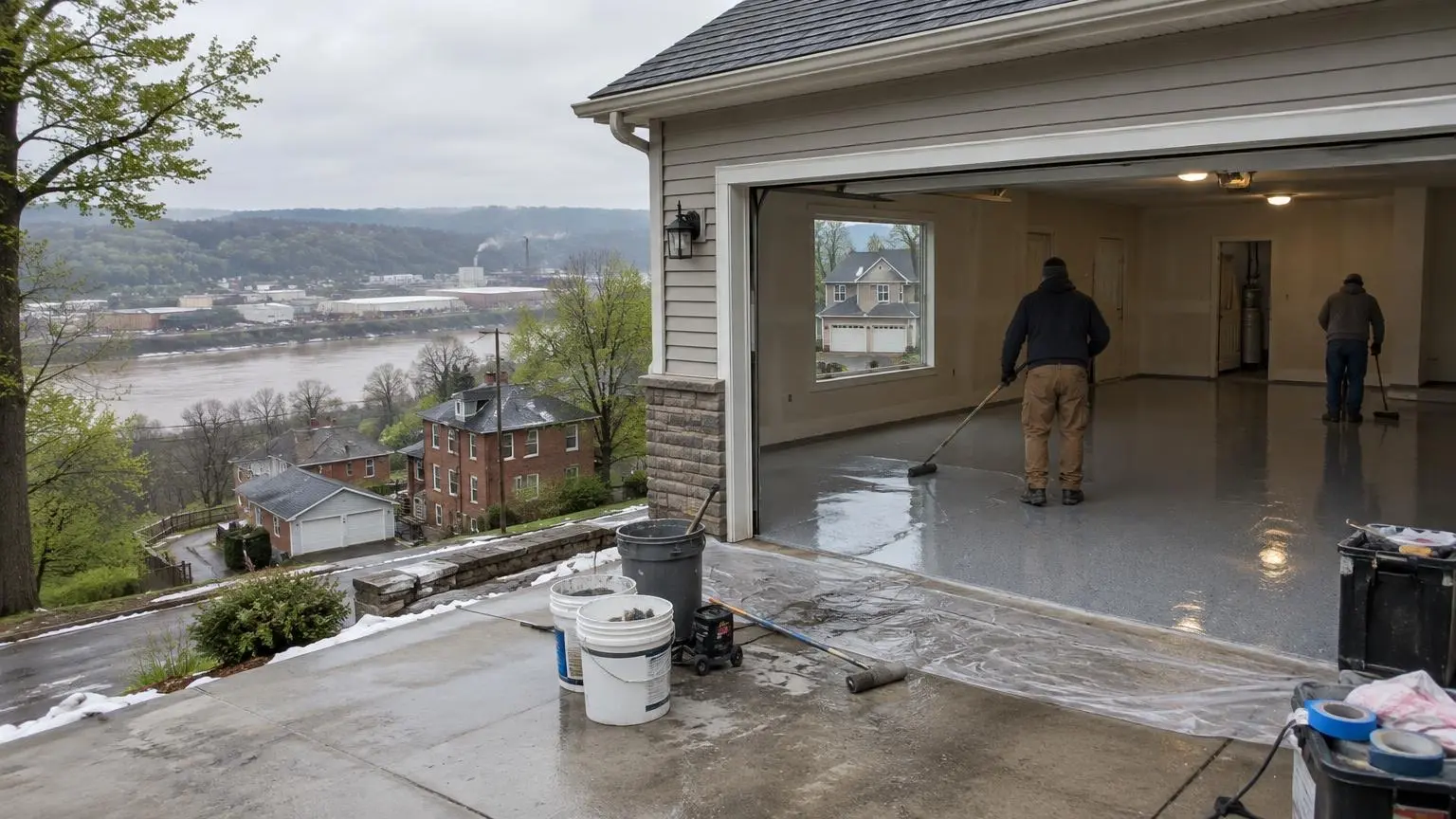
Seven hills, one big river, a lot of old concrete
Epoxy Flooring in Cincinnati, OH
Coatings planned around Queen City slabs: aged, sometimes damp, and asked to handle salt, heat and heavy use.
- No-cost estimate at your place, including a moisture reading on the concrete before any system is suggested
- A quote on paper itemizing surface prep, each coat and the final total
- Surface prep explained up front: grinding, crack repair and old coating removal
Coating Concrete in an Older River City
Epoxy Flooring in Cincinnati often means coating concrete that is older than the people who own it. Point2Homes, citing Census figures, gives 1951 as the median build year for a Cincinnati home, and 40.8% of local housing went up in 1939 or before. A detached garage behind a brick house in Northside or a basement under a Price Hill two-family has usually seen decades of oil, patch jobs and paint. We plan every floor here around that history before we talk about colors.
What an old slab needs first
Older concrete is rarely flat, clean or dry. Expect us to look for three things on the first visit:
- Old coatings and sealers. Paint and cheap kits block a new coating from bonding, so they come off by grinding.
- Cracks and spalls. We fill and level them so the finish does not telegraph every flaw.
- Moisture. We test the slab, since many pre-war floors were poured with no vapor barrier under them.
That prep is where most of the labor goes on an older Cincinnati floor, and your written quote will show it line by line.
Summer heat and humid air
Wikipedia's climate summary describes Cincinnati summers as hot and humid, with highs at or above 90 F on about 27 days a year. Thick summer air matters for coatings. Damp air can leave a cloudy film on some epoxies and shorten working time. On sticky days we watch the dew point, run fans or dehumidifiers in enclosed spaces, and may choose a polyaspartic topcoat that tolerates the conditions better.
Winter slush on the garage floor
The same source lists about 23.3 inches of snow in an average winter and January lows near 23.6 F. That means treated slush dripping off cars for weeks at a time. Road salt sitting on bare concrete eats at the surface and leaves white crust. A sealed, non-porous coating lets you squeegee the melt out the door instead, and a flake broadcast keeps footing secure on a wet slab.
Flood history and low ground
The Ohio River crested at 79.9 feet in January 1937, flooding roughly 12 square miles of the city. Today flood walls guard downtown, but low streets near the river and creek valleys still see water. If your garage or basement has ever taken on water, tell us. We look for staining and efflorescence, and we will say plainly if a drainage fix should come before any coating.
Get a free estimate or call (513) 822-5162.
Work floors for a working city
Kroger employs more people here than any other company, and Procter & Gamble, Fifth Third and other large firms keep headquarters here. Behind the offices are kitchens, loading docks, labs and shops that need a floor they can hose down. We install thicker commercial systems with marked aisles and plan the work in phases so a business can stay open.
Cincinnati Facts That Shape a Floor
- Very old housing stock. The median home was built in 1951, and 40.8% of housing units date from 1939 or earlier (ACS figures via Point2Homes).
- Hot, humid summers. Highs reach 90 F or more on about 27 days a year in a humid continental climate at its southern edge.
- Snow and road salt season. An average winter brings about 23.3 inches of snow, with January lows averaging 23.6 F.
- The 1937 crest. The Ohio River reached 79.9 feet on January 26, 1937, flooding about 12 square miles of the city.
Cincinnati Questions
Will a coating hold on a garage slab from before World War II?
Usually, yes. Older slabs take more grinding and patching, and we test them for moisture because many have no vapor barrier. If a slab is badly broken or wet, you hear that from us before any money goes into a coating.
Will road salt damage an epoxy floor in Cincinnati?
A properly cured coating is far more resistant to salt than bare concrete. Salt and slush still look messy, so rinse or squeegee the floor now and then through winter. A flake finish hides the residue between cleanings.
Is summer humidity a problem during installation?
It can be if nobody watches it. We check temperature, humidity and dew point before we mix anything and adjust the products or schedule when the air is too damp.
Do you work on basement floors in two-family homes?
Yes. Basements in older Cincinnati buildings often need moisture testing and crack repair first. We explain what the readings mean and which systems suit a below-grade floor.
Free Estimates in Cincinnati, OH
Book a no-cost visit and get a written quote for your Cincinnati garage, basement or shop.
Epoxy Flooring Near Cincinnati
- Epoxy Flooring in Mason, OH
- Epoxy Flooring in West Chester Township, OH
- Epoxy Flooring in Blue Ash, OH
- Epoxy Flooring in Sharonville, OH
- Epoxy Flooring in Montgomery, OH
- Epoxy Flooring in Loveland, OH
- Epoxy Flooring in Indian Hill, OH
- Epoxy Flooring in Madeira, OH
- Epoxy Flooring in Anderson Township, OH
- Epoxy Flooring in Milford, OH
- Epoxy Flooring in Fairfield, OH
- Epoxy Flooring in Springdale, OH
- Epoxy Flooring in Forest Park, OH
- Epoxy Flooring in Norwood, OH
- Epoxy Flooring in Wyoming, OH
- Epoxy Flooring in Lebanon, OH
- Epoxy Flooring in Liberty Township, OH
- Epoxy Flooring in Green Township, OH
- Epoxy Flooring in Colerain Township, OH
- Epoxy Flooring in Delhi Township, OH
- Epoxy Flooring in Covington, KY
- Epoxy Flooring in Florence, KY
- Epoxy Flooring in Fort Thomas, KY
- Epoxy Flooring in Union, KY